



eCash (XEC) was designed to provide a consistent user experience for digital cash payments.
For users, this means transactions should remain fast and reliable at all times. Deposits and withdrawals should continue processing normally, confirmations should remain predictable, and moving funds between wallets and exchanges should not become difficult because of changing network conditions.
On proof-of-work (PoW) networks, rapid price movements can directly affect mining profitability and cause sudden changes in hashrate. On minority SHA-256 chains, this can lead to unstable block production, delayed confirmations, and degraded usability.
The Regular Heartbeat upgrade was introduced on eCash specifically to reduce these effects and improve the consistency of block times under changing mining conditions. This article explains how Heartbeat works in action, why block interval stability matters for user experience, and how the network behaved during a period of elevated market volatility.
Mining Profitability and Block Production
eCash uses the SHA-256d mining algorithm, the same algorithm used by Bitcoin (BTC) and Bitcoin Cash (BCH).
Because multiple chains share the same mining algorithm, mining pools can switch hashpower between chains depending on profitability. When the price of a coin increases, mining that coin becomes more profitable, and additional hashpower is typically directed toward the network.
As more miners join the network, blocks are found more quickly, and the mining difficulty increases. This is expected behavior. The issue arises when the market begins to correct.
Difficulty adjustment algorithms react based on previous block production, which means there is always some delay before the difficulty fully adapts to changing mining conditions. If profitability falls while the difficulty remains elevated, miners may switch to another SHA-256 chain. When enough hashrate leaves the network, block intervals can increase significantly until the difficulty readjusts.
Historically, minority SHA-256 chains have experienced periods when blocks were produced much more slowly during volatile market conditions. This affects the user experience directly. Deposits and withdrawals take longer to confirm, exchanges may require additional waiting time, and moving funds between platforms becomes less efficient.
Avalanche and Confirmations
Avalanche improves transaction security and finality on eCash.
With Avalanche Pre-Consensus, transactions can reach finality in a few seconds. In this state, the network has already reached agreement on the validity of a transaction and is actively rejecting conflicting double-spends before they can be included in a block.
In practice, this means transaction finality no longer depends on block inclusion in the same way as traditional proof-of-work systems. However, most exchange infrastructure has not yet integrated Pre-Consensus into their deposit and withdrawal systems.
These systems were originally designed around block-based settlement models used by BTC and similar chains, where confirmation is derived from block depth rather than mempool consensus. Adapting to Pre-Consensus requires exchanges to rely on mempool-level transaction finality rather than block inclusion, which represents a significant change from their current settlement built around block-based confirmation logic.
Until this upgrade is widely adopted, exchanges continue to operate using their existing model, which is based on one block confirmation for eCash deposits and withdrawals, thanks to the Avalanche Post-Consensus upgrade. As a result, block production consistency still plays a practical role in exchange-facing user experience today. Heartbeat helps improve stability in this layer of the system.
How Heartbeat Works

Heartbeat is a real-time target system that limits how quickly effective mining difficulty can increase during periods of rapid block production. When blocks are found unusually quickly, Heartbeat temporarily applies a stricter effective target than the target produced by the standard Difficulty Adjustment Algorithm. This makes extremely fast consecutive blocks more difficult to mine.
The restriction decreases over time until it converges with the normal target from the DAA. Heartbeat does not stop fast blocks from happening. During periods of increased profitability, blocks can still be found faster than average. The goal is to reduce the size of sudden swings in block production and difficulty.
Without Heartbeat, a rapid increase in profitability can cause the difficulty to rise aggressively. If the market then corrects, miners may leave before the difficulty has time to adjust downward again. This can lead to very slow block intervals.
Heartbeat helps smooth this process by reducing how aggressively the effective difficulty increases during sharp market movements. This reduces the likelihood of severe confirmation delays during market corrections.
With Heartbeat, eCash’s average block time aligns closely with BTC, reflecting improved stability in block production and network behavior.
Heartbeat During Real Market Volatility
On May 10th, 2026, XEC experienced a sharp price movement followed by a correction and stabilization phase. This provided a clear real-world example of how mining behavior and block production react under changing economic conditions.
For analysis, the period can be viewed as a single 24-hour window during which market-driven changes in profitability affected hashpower allocation across SHA-256 chains.
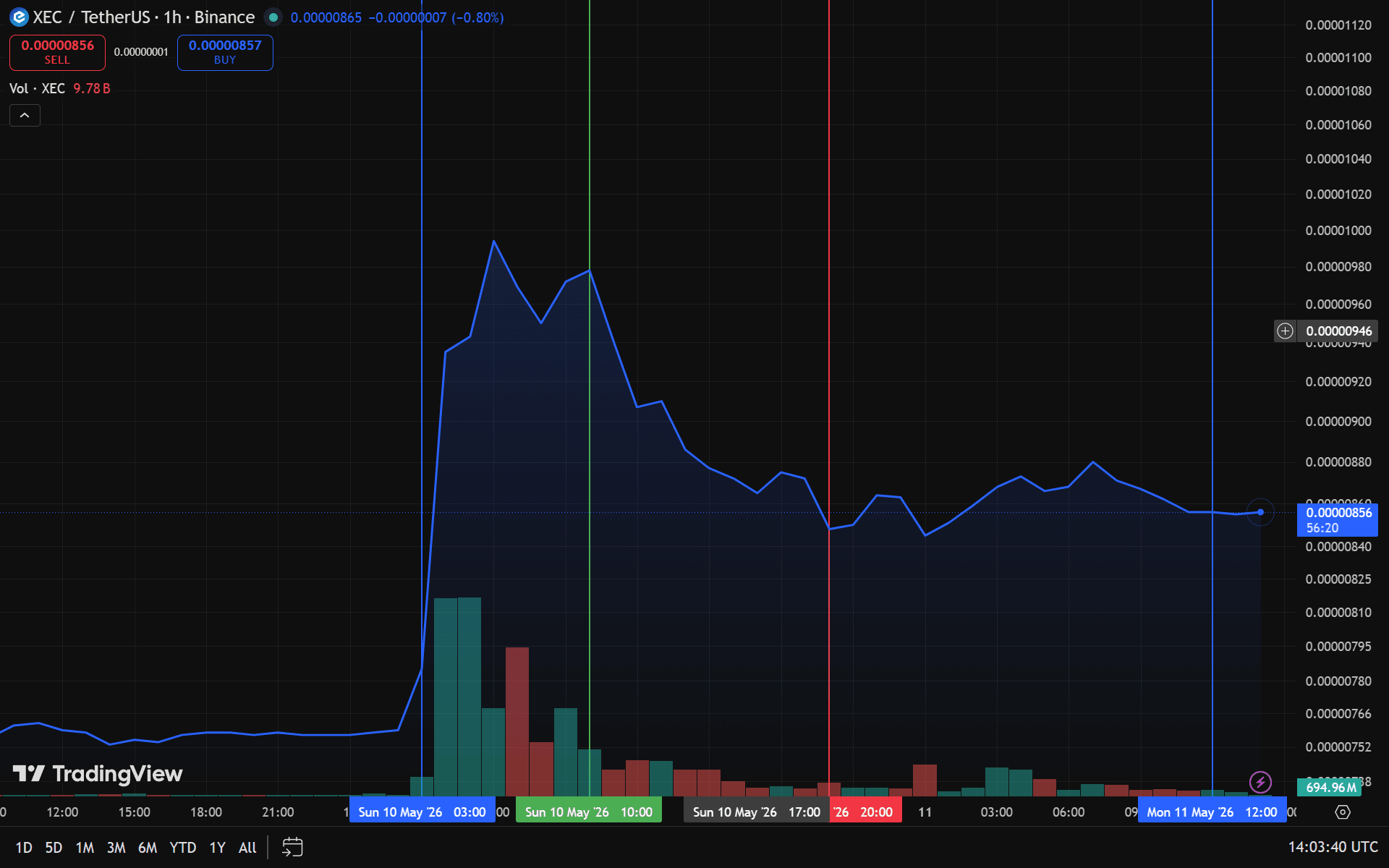
The sequence of events followed a typical structure:
During the initial upward phase, the increase in price improved mining profitability. As a result, additional hashpower was directed toward eCash. Blocks were found faster than baseline, and the Difficulty Adjustment Algorithm began increasing difficulty in response to the higher observed block rate.
This first phase behaves as expected. As long as profitability continues to rise or remains elevated, miners maintain or increase allocation, and block intervals remain compressed relative to the long-term average.
The second phase begins when price momentum reverses. As the market entered correction, profitability started to decline while difficulty remained elevated due to prior high-hashrate conditions. This creates a lag between real-time mining incentives and the difficulty level enforced by the protocol.
At this point, mining eCash becomes less competitive relative to other SHA-256 chains. Mining pools begin reallocating hashpower away from eCash toward more profitable targets. As hashpower decreases, block intervals naturally begin to expand.
This is the critical phase where minority SHA-256 chains are typically most affected. The difficulty has not yet fully adjusted downward, but hashrate is already leaving. The result is a temporary mismatch that can lead to significantly slower block production.
Historically, in such conditions, block intervals can expand from the expected 10-minute range into much longer gaps until the Difficulty Adjustment Algorithm converges back toward equilibrium.
The final phase occurs once difficulty eventually readjusts downward in response to reduced block production. At that point, mining becomes profitable again under the new conditions, hashpower stabilizes, and block intervals return to normal ranges.
Heartbeat reduces the severity of this entire transition by preventing excessive upward overshoot in difficulty during the initial expansion phase. This limits how far the system can drift during the peak, which in turn reduces how severe the correction phase becomes when profitability declines.
Some numbers to demonstrate the Heartbeat effect
At the beginning of the observed interval (block 948414), the overall network hashrate was about 48.70 PH/s. At the end of the interval (block 948598), it was about 53.71 PH/s. The difficulty increased steadily across the full period.
The lowest block interval was 117 seconds (about 2 minutes) and the highest was 1859 seconds (under 31 minutes). The mean block interval was 469 seconds (7'49"), and the median was 410 seconds (6'50"). The difference between mean and median reflects the presence of a small number of longer intervals, while most blocks were found faster than average.
Block timestamps are not perfectly precise, since miners can adjust timestamp fields within protocol limits. This introduces small measurement errors, but does not affect the overall conclusions.
A total of 185 blocks were mined over 24 hours, compared to the expected 144 under a stable 10-minute interval model. This is consistent with increased mining activity during the upward phase of the market cycle.
Despite this volatility, the network remained operational throughout. Deposits and withdrawals continued to process normally, and there was no observable degradation in usability. Some variation in block intervals is normal for proof-of-work systems due to the probabilistic nature of block discovery. Even in flat market conditions, long intervals can occasionally occur.
Conclusion
User experience is like salt in a meal: it becomes noticeable only when it is lacking.
Despite a full cycle of rapid price increase, correction, and stabilization, the eCash network continued operating without visible disruption.
Heartbeat reduces the impact of mining-driven volatility on block production by smoothing extreme shifts in difficulty and hashrate behavior. Together with Avalanche, it contributes to maintaining consistent usability during changing market conditions.
In most cases, these mechanisms remain invisible to users.
That is the intended outcome of good system design.
